Voodoo, hoodoo. People say them back to back like they're the same word with a typo. They're not. Close, sure. Same rough family tree, same continent of origin, sometimes even the same ingredients sitting on two very different altars.
Contact me by WhatsappBut mix them up while you're actually trying to work a ritual, instead of just admiring the aesthetic from your phone, and you'll end up confused fast.
I get some version of this question a lot. Someone read three sites, got three answers that contradicted each other, gave up trying to figure out which tradition their own love spell was supposed to belong to. Makes sense. Half the internet conflates the two on purpose. The other half just doesn't know better.
So. Real breakdown. Where each one comes from. What a love ritual looks like inside each tradition. What's genuinely different, not just cosmetically different. And which one might actually suit your situation.
Fair warning before we start: this isn't a ranking. I'm not here to tell you one tradition beats the other. Anyone who tells you that is usually trying to sell you something from whichever side they're standing on.
Two Traditions, One Shared Root
Both start in West Africa. That part, at least, everyone gets right. Voodoo, or Vodun in its original form, grew into a complete religion across what's now Benin, Togo, parts of Nigeria. Priesthood. A pantheon, each spirit with a name and a job. Structure wrapped around nearly everything a person goes through, birth, marriage, death, and yes, matters of the heart.
Hoodoo came out of something rougher. Born in the American South during slavery, when West African spiritual knowledge slammed into European folk magic and whatever Indigenous plant knowledge could be picked up nearby. Forced to adapt fast. In secret. No temples. No formal priesthood the way Vodun still had back home. You can't build a temple on a plantation. So the knowledge went underground. Passed hand to hand. Mother to daughter. Elder to whoever was trusted enough to learn it.
That's the split, short version. Vodun stayed a religion. Own gods, own priests, theology underneath every single ritual. Hoodoo turned into something else, a folk practice, a toolkit, one that doesn't demand any specific religious belief attached to it. Plenty of hoodoo practitioners were, and still are, devout Christians. You can't really "practice Vodun" in that same pick-and-choose way. It comes as a package. A whole worldview, not a set of borrowed techniques.
Someone put it to me once in a way I never forgot.
I've quoted that line back to more people than I can count since.
How the Two Traveled Differently
Quick detour, but it explains a lot of what comes later. Vodun stayed rooted in some places, traveled hard in others. In Benin, towns like Ketou specifically, the tradition barely got interrupted at all. Knowledge kept flowing, generation to generation, mostly intact. Priest Codanto, who's worked out of Ketou since 1980, trained the same basic way priests trained a hundred years before him. Years under elders. Not a weekend course. When Vodun crossed the Atlantic in chains, it took root again in Haiti as Vodou, blending with Catholicism into something related but genuinely its own. Louisiana got its own branch too, sometimes just called Louisiana Voodoo.
Hoodoo never had one homeland to leave from. It was born already moving, already improvising. Not a weakness, that. Kind of the whole reason it turned out so practical, so material-focused. Can't build a temple? Build a tradition around what's already in your hands. Herbs growing by the road. Kitchen items. Whatever wouldn't get you punished for having it.
Makes me think, actually, about why people call hoodoo "simpler" than Vodun. It's not simpler. It's portable. A ritual you can carry entirely in your head, using what's already in your kitchen, survives conditions that would wipe out anything requiring a temple or a fixed priesthood. That portability isn't a downgrade. It's the reason the whole tradition made it here at all.
Names, Spirits, and What Hoodoo Doesn't Have
Here's a detail that trips people up. Vodun's spirits carry different names depending on where you land. Benin: vodun, confusingly the same word as the religion itself. Haiti: loa, or lwa. Each one runs something specific. Love. War. The crossroads. The sea. Each has favorites, colors, days, foods they're offered.
Hoodoo doesn't come with a built-in pantheon the same way. Trips people up who assume every tradition needs its own cast of named spirits. Some Christian hoodoo practitioners call on saints or biblical figures, a real and rich thread within the practice, but that's layered on top, not baked into hoodoo's actual foundation the way the loa are baked into Vodun's.
What Makes a Love Spell "Voodoo"
A Vodun love ritual sits inside something much bigger than the ritual itself. Divination usually comes first. Reading signs. Cowrie shells. Whatever method the priest actually trained in. Understanding what's really going on before doing anything else. The spirits get consulted, not just invoked like tools off a shelf. Consulted, the way you'd ask someone with decades more experience for their read on something you can't see clearly yourself. A Houngan or Mambo, male and female priest, usually performs this. Someone who spent real years under other priests before anyone let them work alone.
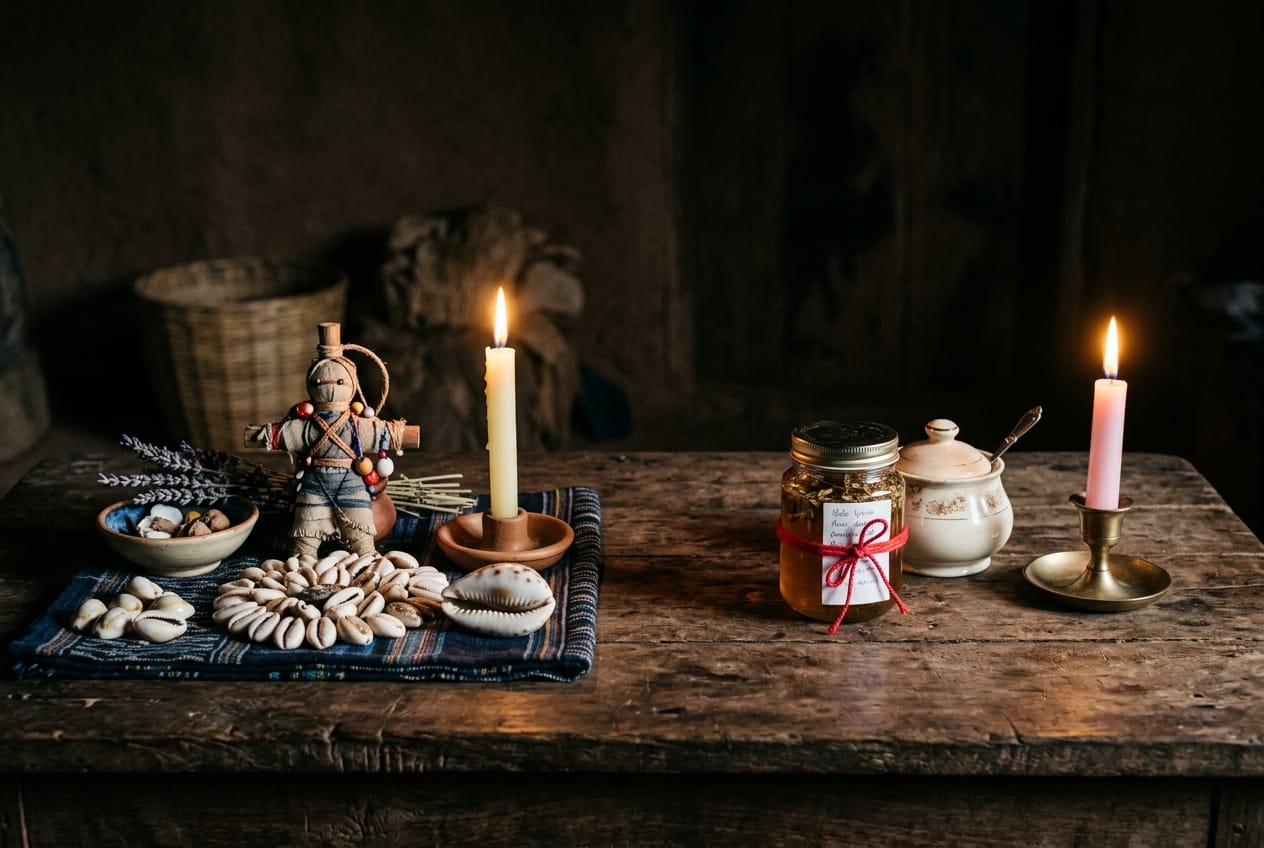
Codanto once described it to me in a way that stuck. Less like casting a spell. More like asking for help from people who've done this far longer than you have. Ancestors. The specific spirits tied to love. The materials, red-headed pins, a small doll, lavender, verbena, these aren't random props. They carry meaning inside a whole worldview.
Here's the shape of a classic Vodun love working, simplified. Enough to show you the bones, not enough to replace years of training, so don't mistake it for that.
A doll standing in for the person (cloth or burlap), something that's actually theirs (hair, a photo, nail clippings if you can get them), a red-headed pin, a white candle, dried lavender.
Light the candle first. Let it settle. Hold the doll. Focus, actually focus, on the person's real face, not some vague idea of them. Push the pin into the doll's heart slowly while staying focused, then speak the intention out loud, clearly. Light the lavender, hold the doll over the smoke till the scent fills the room, then tuck it away somewhere private and undisturbed.
That's the skeleton of it. Codanto's full version runs much longer, includes a specific invocation from his own training. This is just the shape.
Notice what's missing if you read the steps flat, mechanically. No religious framing written in. No ancestors named. No spirit called on directly. That gap right there, between doing the mechanics and actually practicing the tradition, is the whole point. A trained Houngan carries that invisible structure into the room whether it's written down or not. Someone copying steps off a blog post doesn't, even holding the exact same candle.
Someone asked me once why that gap even matters if the outside steps look identical either way. Fair question. Think of it like the difference between someone who's memorized a few phrases in a language and someone who actually grew up speaking it. Same words might come out of both mouths. Only one of them is actually thinking in that language while they speak.
What Makes a Love Spell "Hoodoo"
Hoodoo runs differently. More accessible too, honestly, without formal training, which is a lot of why it spread the way it did. No priesthood gatekeeping the door. No initiation you have to pass through first. A rootworker, the term most hoodoo practitioners actually use for themselves, learns through apprenticeship or family too, but the bar for simple personal work sits much lower than Vodun's.
Honey jar. Probably the most recognized hoodoo love ritual out there. Good example of how the tradition generally works. Practical. Ingredient-driven. Less about invoking one named spirit, more about correspondences, using materials that symbolically already carry the quality you're after.
A small jar with a lid, honey, paper, red or pink string, a candle (a figure candle if you've got one, plain works too), something personal from both people if it's for an existing relationship, or from yourself if you're attracting someone new.
Write both names on the paper. Sometimes crosswise, one name over the other, depends who taught you. Fold it toward yourself. Fill the jar partway with honey. Drop in the paper. Tie the string around the neck of the jar. Set the candle on top. Burn it down over several days, relighting as needed, holding the intention every time.
The honey's doing the symbolic heavy lifting, sweetening how the person feels, sweetening the relationship itself, similar logic to the honey-and-photo rituals you'll spot on voodoo sites too, since the two traditions swapped ideas plenty over a couple centuries living close together.
What's missing here, compared to the Vodun version above: no divination step, no named spirit consulted, no priesthood needed to do it "right." Built for one person, alone, no intermediary. Feature, not shortcut.
Worth saying plainly, since it's easy to read that gap as a knock against hoodoo. It isn't one. A tradition built for someone working alone, under threat, with no access to formal structure, had to be efficient by necessity. That efficiency stuck around long after the original danger passed, because it turned out to just work.
A Second Hoodoo Ritual: The Sugar Bowl
Less famous than the honey jar. Different flavor of the same tradition though, ongoing instead of one-and-done.
A small bowl with a lid, sugar, paper with the person's name on it, a small personal item if you've got one.
Write the name, fold it, place it in the bowl, cover it in sugar, add the item, close the lid. Keep the bowl somewhere in your home. Every so often, stir the sugar gently, thinking about the relationship you're trying to sweeten. Daily for some people. Weekly for others.
Less a dramatic single ritual, more a slow, ongoing practice, tending something rather than casting once and just waiting around.
I actually like this one more than most of the flashier rituals out there, personally. Doesn't ask you to believe anything transforms overnight. Asks you to show up, a little, regularly, the exact way a real relationship needs tending rather than one grand gesture followed by months of silence. Whether or not you buy the spiritual mechanics behind it, that structure teaches something true on its own.
Where the Two Traditions Actually Overlap
Article's spent a lot of time on differences so far, fair to flag the overlap too, and it's real, not just borrowed surface decoration.
What both traditions share
- Intention sits above everything else
- Candles, herbs and personal items used as focus points
- Serious botanical knowledge: which plant does what, what amplifies or cancels out
- Flattened by the same Hollywood tropes for a century straight
Both center intention above everything else. Both lean on candles, herbs, personal items as focus points. Both built serious, sophisticated botanical knowledge, which plant does what, what combination amplifies or cancels out. Both got flattened by the exact same Hollywood tropes for a century straight, pins and dolls, curses that neither tradition's love work is actually built around in the first place.
Strip the theology away and just watch two experienced practitioners work, one Vodun, one hoodoo, and you'd see more similarity in focus and care than difference in mechanics. The theology explains why. The care looks nearly identical either way.
The Real Differences, Side by Side
Worth laying it out plainly, since the two get smushed into one blurry thing online constantly.
| Voodoo (Vodun) | Hoodoo | |
|---|---|---|
| Religious framework | A religion, gods and cosmology included. | Needs no particular belief system; coexisted with Christianity for most of its practitioners historically. |
| Who does the work | Past the simplest home ritual, usually a trained priest, initiated within a lineage over years. | Built for the individual, though people do hire experienced rootworkers for bigger situations. |
| Spirits | Specific named ones, loa or vodun, each with a domain and preferences. | Leans on the properties already inside materials (honey sweetens, red draws passion) without necessarily naming an entity. |
| Geography | Stayed close to West Africa, strongest in Benin, Togo, Haiti, parts of Louisiana. | Grew specifically in the American South, tied to the lived history of enslaved West Africans. |
| Structure | Usually opens with divination. | Tends to skip straight to the working: pick the correspondence, gather it, do the ritual. |
| Initiation | Becoming a Houngan or Mambo generally requires formal initiation, sometimes years of preparation. | Skill usually comes through apprenticeship and practice, not a formal ceremony, though serious mentorships exist. |
Religious framework. Vodun's a religion, gods and cosmology included. Hoodoo needs no particular belief system, coexisted with Christianity for most of its practitioners historically.
Who does the work. Vodun, past the simplest home ritual, usually goes through a trained priest, initiated within a lineage over years. Hoodoo's built for the individual, though people do hire experienced rootworkers for bigger situations.
Spirits. Vodun has specific named ones, loa or vodun, each with a domain and preferences. Hoodoo leans on the properties already inside materials, honey sweetens, red draws passion, without necessarily naming an entity to do it.
Geography. Vodun stayed close to West Africa, strongest in Benin, Togo, Haiti, parts of Louisiana. Hoodoo grew specifically in the American South, tied to a lived history of enslaved West Africans adapting real knowledge under circumstances nobody should've had to adapt under.
Structure. Vodun opens with divination, usually. Hoodoo tends to skip straight to the working, pick the correspondence, gather it, do the ritual.
Initiation. Becoming a Houngan or Mambo generally requires formal initiation, sometimes years of preparation. Becoming a skilled rootworker usually comes through apprenticeship and practiced skill, not a formal ceremony, though serious mentorships absolutely exist here too.
None of this makes one more "powerful" than the other. Whatever some page trying to sell you a spell claims. Different tools, shaped by different circumstances. A real practitioner from either side tells you that straight instead of pretending their own tradition is the only legitimate one left standing.
I asked Codanto directly once whether he thought Vodun was "stronger" than hoodoo. He laughed. Said something close to this:
Take that for what it's worth, coming from someone forty-plus years deep in one tradition, choosing not to claim superiority over another he respects without practicing.
Which One Should You Actually Choose
Comes down to what you actually need. Not which word sounds more mysterious on a website.
Quick way to choose
- Want something you can do yourself, privately: hoodoo is the more accessible starting point
- Dealing with a suspected curse, generational family conflict, or something bigger than ordinary friction: a Vodun approach through a real, trained priest reaches further
- Not sure yet: start simple, and move to a trained priest if the situation turns out deeper
Want something you can do yourself, privately, without hunting down and vetting a trained priest first? Hoodoo's the more accessible starting point. Honey jar, sugar bowl, neither demands initiation or lineage to attempt honestly.
Dealing with something heavier? A suspected curse, generational family conflict, something that feels bigger than ordinary relationship friction? A Vodun approach through a real, trained priest tends to reach further, since that divination step exists specifically to catch things a simpler working might miss or misread entirely.
There's a version of this decision that comes down to risk tolerance too, honestly. A hoodoo working you do alone costs you nothing but your own time and a jar of honey if it doesn't land the way you hoped. Reaching out to a trained priest for something deeper is a bigger commitment, more time, more cost, more trust placed in someone else. Neither choice is wrong. Just worth knowing which kind of risk you're actually comfortable taking on before you start.
Geography and personal pull matter more than people admit too. Haitian or Louisiana Creole heritage might pull someone toward Vodun specifically, closer to home than they realized. Southern African American tradition might pull someone else toward hoodoo instead. Neither pull's required to practice either one respectfully, but worth being honest with yourself about why a path is calling before diving in.
Doesn't have to be locked in forever either. Plenty of people start with the more accessible hoodoo work, get a feel for how ritual sits with them, decide later a deeper situation calls for the structure a trained Vodun priest offers. Nothing wrong with starting simple. If what you're dealing with isn't only romantic, family, friendship or work, our guide to relationship spells covers those too.
Common Misconceptions Worth Clearing Up
Voodoo dolls are for cursing people.
Not primarily, in either tradition. The doll's a focus tool, standing in for concentrated intention, used more for love, healing, protection than harm across both practices. The horror movie version did real damage here.
Hoodoo's just voodoo without the religion, so it's the lesser version.
No. Parallel developments, not a stripped copy sitting in the other's shadow. Hoodoo built its own deep body of knowledge across centuries under brutal conditions. Calling it "voodoo-lite" disrespects something standing entirely on its own.
You need African ancestry to practice either one.
More nuanced than yes or no. Both traditions have living communities guarding their knowledge carefully, for good reason, given how often both got stolen and sold cheap online by people with no real connection to either. Respectful practice generally means learning from an actual practitioner, not assembling a version from scattered blog posts.
They're basically the same thing with different names.
The single most common mix-up, and hopefully this piece cleared up why that's not quite right. Related, yes. Interchangeable, no.
A love spell from either tradition can force someone to fall in love who has zero feelings there.
Neither tradition, practiced honestly, claims this. Both work with something already present and aim to clear whatever's blocking it. Anyone promising otherwise is selling something, not practicing a real tradition.
Voodoo and hoodoo are both "black magic."
Neither term maps onto that phrase the way people assume. Both traditions include work aimed at protection, healing, and love far more than anything resembling the Hollywood idea of black magic, and both have their own internal ethics about what a practitioner should and shouldn't agree to do for a client.
A Quick Word on Blending the Two
People mix elements from both. Happens more than either tradition's strictest defenders would probably like. Not automatically wrong, but it works better when you actually understand what you're borrowing rather than grabbing pieces at random because they looked interesting on a Pinterest board.
A trained practitioner from either side can usually spot the difference between informed blending and someone guessing their way through it. Combining approaches? Know at minimum which piece came from where, and treat both traditions with the seriousness you'd want your own beliefs treated with.
Situation feels bigger than a honey jar?
Priest Codanto has practiced traditional Vodun from Ketou, Benin since 1980. He starts with questions about your situation, not a pitch.
Message +229 56 94 95 65 on WhatsAppFrequently Asked Questions
Can I mix voodoo and hoodoo techniques in one ritual?
People do. Not automatically wrong, goes better when you actually understand what each piece is doing rather than combining things at random.
Is one tradition more effective for love spells specifically?
Not inherently. Comes down mostly to focus and intention, not which tradition technically performed the ritual. Both have long, documented histories of practitioners reporting real results.
Do I need to find a priest for hoodoo love spells the way I would for voodoo?
Generally not, for simpler work like the two rituals above. Hoodoo's built around individual practice from the start. Plenty of people still consult an experienced rootworker for bigger, more tangled situations though.
Where can I find a legitimate voodoo priest for this kind of work?
Priest Codanto has practiced traditional Vodun from Ketou, Benin since 1980, works with clients across the US, Canada, and Europe through WhatsApp. Straightforward about what he does and doesn't do, starts every conversation with questions about your situation rather than a pitch. Reach him at +229 56 94 95 65.
Is it disrespectful to try a hoodoo ritual if I'm not African American?
Genuinely mixed opinions inside the hoodoo community itself. Widest-shared guidance leans toward learning from real practitioners, crediting the tradition honestly, not marketing yourself as a trained rootworker without the grounding to back it.
How do I know if a "voodoo" or "hoodoo" spell caster online is legitimate?
Same red flags across both. Vague claims, no real lineage mentioned. Guaranteed instant results. Pressure to pay before any real explanation. A legitimate practitioner from either tradition explains their background, asks about your situation first, never promises what honest spiritual work can't actually guarantee.
Can a hoodoo rootworker and a voodoo priest work on the same situation together?
Not common. Different frameworks, most practitioners stay within their own lineage rather than blending client work across both. Possible in theory. Rare enough in practice that it's not something to plan around.
Does one tradition have a stronger reputation for love work specifically?
Both have deep, long-documented histories around love and relationship work specifically, arguably more than almost any other category in either tradition. Neither holds a clear edge. Online reputation tends to reflect marketing more than actual tradition, worth remembering whenever a site claims one's objectively "better."
Can a love spell from either tradition be reversed if I change my mind?
Usually, yes, though it depends heavily on what was actually done and how strong the original working was. Vodun work through a trained priest is often easier to reverse properly since the priest understands exactly what was set in motion. A solo hoodoo working is generally more straightforward to undo yourself too, since you're the one who performed it and know its exact shape.
Voodoo Love Spells vs Hoodoo Love Spells: The Real Takeaway
Voodoo and hoodoo share real roots, grew out of the same original West African knowledge, but turned into genuinely different things over time. One a structured religion with its own priesthood and spirits. The other a flexible, practical folk tradition anyone willing to learn seriously can practice. Neither's a watered-down copy of the other. Neither guarantees better results just because of the name on the label.
I'll say this last part plainly, since it's easy to lose in all the detail above. Both of these traditions kept people alive, spiritually and sometimes literally, through conditions most of us reading this will never have to face. That history deserves more respect than either gets in most of the content floating around online, the stuff that reduces one to a punchline and the other to a stock photo of candles and crystals.
Pick based on what actually fits. How complicated the situation is. Whether you'd rather work alone or with a trained priest at your side. Not whichever word sounds more mysterious on a webpage somewhere. Both traditions survived centuries of disruption, distortion, and outright theft because they work for the people practicing them with real seriousness. Worth more than any marketing claim either side could make about the other.
Still not sure which fits, even after all this? Completely normal place to land. Sit with it a while longer. The right choice usually gets obvious once you're honest with yourself about what you're actually trying to solve. And if you'd rather talk it through with someone trained, the contact page is the easiest place to start.