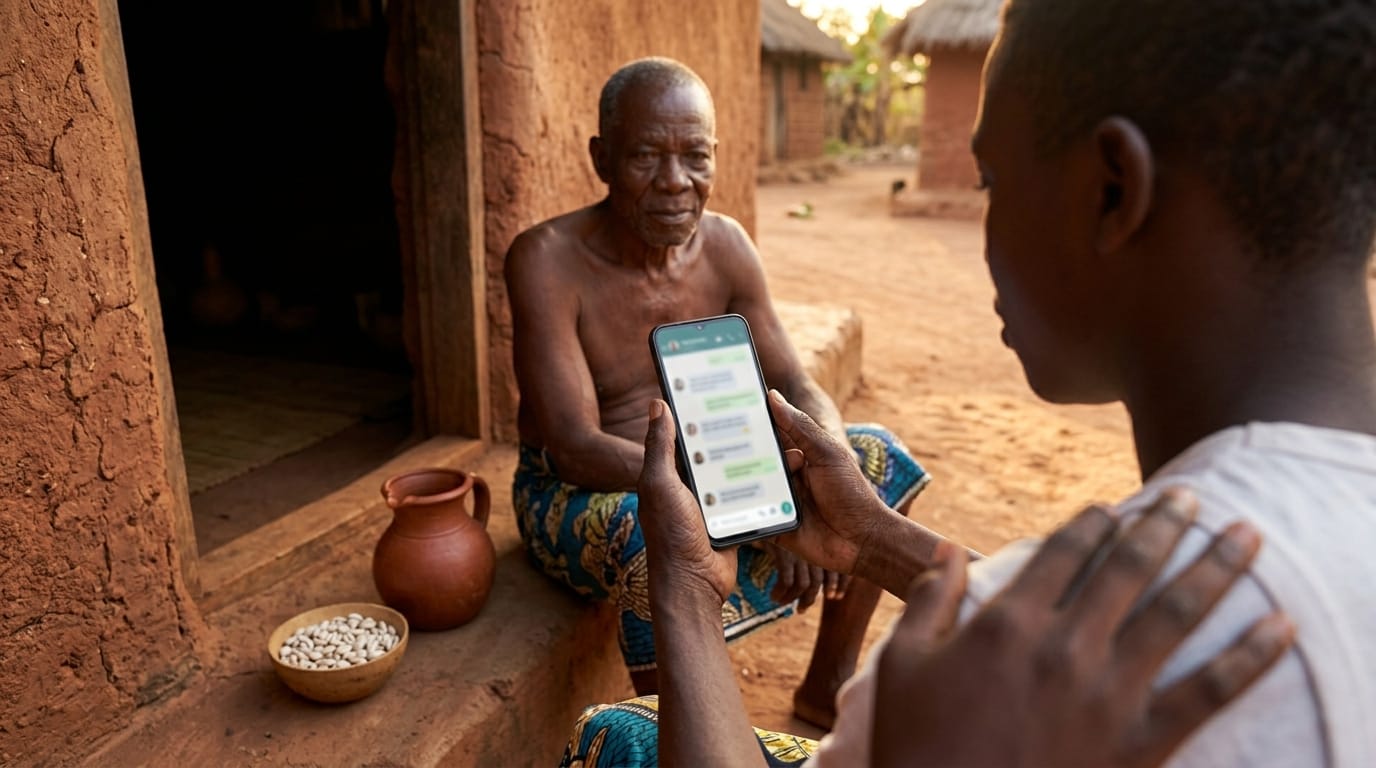
WhatsApp is the way most people reach a voodoo priest, and it is also where fake profiles and scams operate. This page explains the real risks, what never to send, and how to check who you are talking to.
Contact me by WhatsappYes, it can be safe to contact a voodoo priest on WhatsApp, as long as you protect yourself the way you would with any stranger online. The app itself is private. The risk comes from who is on the other end and what you agree to send or pay. If you keep your verification codes to yourself, share no sensitive documents, check that the person is who they say they are, and never pay under pressure, a first conversation on WhatsApp costs you nothing and risks very little. This page explains the real dangers, how to avoid them, and what a first message to a genuine priest should look like.
My name is Priest Codanto. I have practiced voodoo in Ketou, Benin, since 1980, and WhatsApp is the way most people reach me, from Europe, North America, and across Africa. Because so many people ask me whether it is safe, and because some of them have already been hurt by others, I want to give you a straight and practical answer.
Why Most Priests Use WhatsApp
It helps to understand why this is the normal channel. People who seek help from a voodoo priest are spread across many countries. A priest practicing in Benin cannot meet most of them in person, and the oldest forms of contact, such as letters or long journeys, are no longer realistic for most people.
WhatsApp is free or very cheap, it works on almost any phone, it allows voice messages as well as text, and it lets you speak to the priest directly. For the person seeking help, it also feels more personal than a web form, because you are writing to a human being and not to a company.
That convenience is also why fraudsters use it. A scammer can open a WhatsApp account in minutes, copy a priest's photo and name, and approach people who are searching for help. So the question is not whether WhatsApp is dangerous. It is how to use it without being fooled.
What Is Actually Safe About WhatsApp
Let me start with what is true, so you do not worry about the wrong things.
WhatsApp messages and calls are protected by end to end encryption by default, which means that outsiders cannot read the content while it travels between your phone and the other person's. Chats can be kept private, you can block and report any contact, and you can use features such as disappearing messages if you want a conversation to leave less of a trace.
What the app cannot protect you from is the choices you make inside it. If you give a stranger your verification code, send your identity documents, or transfer money to someone who has not earned your trust, the encryption does nothing. The protections that matter are the ones you apply yourself.
The Real Risks When You Contact a Voodoo Priest on WhatsApp
These are the dangers I hear about most often.
Fake profiles that copy a real priest. Someone takes the name, the photos, and the wording of a genuine priest and offers services under a different number. You believe you are speaking to the priest, but you are speaking to a stranger. This is one of the most common problems, and it is the reason to verify numbers (see below).
Requests for your verification code. A message arrives, apparently from someone helpful, asking you to read out the six digit code that WhatsApp has just sent you. This is not part of any consultation. It is how criminals take over accounts. Anyone who asks for that code is trying to steal your WhatsApp.
Requests for identity documents. "Send a photo of your passport to prove who you are." A genuine consultation never needs this.
Requests for banking details or passwords. Same answer. No ritual requires them.
Pressure to pay immediately. Countdown offers, "last chance today," or a sudden emergency that must be paid for right now.
Fear as a tactic. Messages telling you that you are cursed, that someone has cast a stronger spell on you, or that danger is growing every day, followed by a request for money.
Unsolicited contact. A stranger messages you first, saying they have seen that you are suffering and can help. Genuine priests do not hunt for clients in this way.
Requests for intimate photos or videos. Never send them to anyone in this context. No ritual needs them, and they can be used to threaten you.
Groups and mass messages. Being added to a group where "clients" post praise and a "priest" posts offers is a common way of building fake credibility.
How to Check That You Are Writing to the Real Priest
Before you trust any number, check it. This takes a few minutes and protects you from the most common problem.
- Use the number published on the priest's own website. My WhatsApp number, +229 56 94 95 65, is on this site. If a different number contacts you and claims to be me, ask yourself why.
- Compare the number across places. A genuine priest's number is the same on his site, his contact page, and his articles. If you find different numbers in different places, ask directly which one is correct.
- Check the country code. Benin numbers begin with +229. A number starting with another country code that claims to be a priest in Ketou deserves a question.
- Ask a question only the real person could answer. Ask where he practices, how long he has practiced, and how he decides which ritual to use. Compare the answers with what the website says.
- Be wary of numbers that reach you first. If you did not write to the number, you cannot be sure who is behind it.
If you find that a number is impersonating a priest, you can block and report it in WhatsApp, and you can tell the priest's real contact so that others are warned.
Protecting Your Own Account
A few settings and habits make your own WhatsApp much harder to hijack.
- Never share your six digit verification code with anyone. Not a priest, not a friend, not WhatsApp itself. WhatsApp will never ask for it.
- Turn on two step verification. This adds a PIN that is required whenever someone tries to register your number again. You can find it in the account settings.
- Review your privacy settings. You can control who sees your profile photo, your status, and when you were last online.
- Be careful with links and attachments. Do not open files or links from people you do not know.
- Keep the app updated. Updates fix security problems.
- Think about backups. Chat backups stored in the cloud may not have the same protection as the chat itself unless you enable encrypted backups in the settings.
None of this is special to voodoo. It is ordinary good practice, and it protects you in all areas of life.
What You Should Never Send on WhatsApp
A consultation needs your words and your honesty. It does not need the following.
- Your verification codes.
- Passwords of any kind.
- Banking details, card numbers, or online banking access.
- Copies of identity documents.
- Intimate photos or videos.
- Photos or personal information about other people, unless you understand why they are requested. Some rituals use a name or a photo, and I explain in the consultation what is needed and why. Be cautious if this is requested without explanation. The question of whether a photo or a name is needed is covered in the page about whether a voodoo spell can be done without a photo or the person's name.
- Money before you have spoken to the person and understood what it is for.
What a First Message to a Genuine Priest Should Look Like
Many people worry about what to write. You do not need special words or any ritual language. A first message can be as simple as this: your first name, the country where you live, and a few sentences about the situation you would like help with. You can add what you have already tried and what you are hoping for.
You should not feel obliged to give a lot of detail in the first message. A genuine priest will read what you have written, ask questions if he needs to understand more, and tell you honestly whether he believes he can help. He will not ask for money in the first message, he will not pressure you to decide, and he will not use fear to keep you in the conversation.
What Happens After You Write to Me
Here is how it works with me, so you can compare it with any other practice.
You write on WhatsApp or through the contact page. I read your message and reply myself, not through a call center or a chat agent. I ask questions where I need to understand more. If I think I can help, I explain what a consultation involves. I consult Fa and tell you what the oracle shows, including when it does not say what you hoped to hear. If a ritual is appropriate, I explain what it is for and what it would cost, and you decide. If you decide not to go ahead, that is the end of it, and there is no hard feeling.
The first conversation carries no obligation. You are never asked to pay before you have spoken to me and understood what the payment is for. If you want more on how cost works, I have written a full guide on how much a real voodoo spell costs.
Red Flags in a WhatsApp Conversation
If any of the following appears, slow down.
- The person contacted you first, without being asked.
- The first reply is a price, not a question about you.
- A guarantee of results within a certain number of days.
- A request for a verification code, a password, or a document.
- You are told you are cursed, and that only a payment can remove the curse.
- Payments keep increasing, each justified by a new emergency.
- The person will not speak by voice, will not answer plain questions, or tells a different story each time.
- Reviews or "client stories" are sent as screenshots but cannot be checked.
- You are told to keep the conversation secret from your family.
If you notice two or three of these, stop. You can block the number and report it.
Text, Voice Messages, or a Call: Which Is Safer?
Many people ask whether it is safer to write, to send voice messages, or to speak by phone when they contact a voodoo priest on WhatsApp. None of these is unsafe in itself. What changes is how much you can learn about the person.
Text gives you time. You can think before you reply, reread what was written, and show the conversation to a friend you trust. This is useful when you are emotional.
Voice messages and calls tell you more about the person. You can hear whether they answer plainly, whether they hurry you, and whether their story stays the same. A priest who refuses ever to speak, or who only communicates through pre written messages, gives you less to judge.
My advice is to begin in writing if you feel nervous, and move to voice once you feel comfortable. Whatever the format, the same rules apply: no codes, no documents, no payment under pressure.
If You Think You Have Already Been Scammed
It can happen to careful people, and it is nothing to be ashamed of. If you think you have been scammed:
- Stop sending money and information. Do not try to recover money by sending more.
- Secure your accounts. Change passwords if you shared any, turn on two step verification, and check whether anyone has taken control of your WhatsApp.
- Contact your bank immediately if you shared banking details or sent a transfer. Banks have procedures for fraud, and speed matters.
- Keep records. Save messages, numbers, and payment receipts.
- Report it to WhatsApp, to your local police or fraud service, and to the platform that hosted the advertisement if there was one.
- Talk to someone you trust. Shame keeps people silent, and silence helps scammers.
If you wish, you are also welcome to write to me, and I will tell you plainly what I think of what you were offered. The warning signs of fake offers are explained further in the guide to the best spell caster online.
Frequently Asked Questions
Is it safe to contact a voodoo priest on WhatsApp?
It can be safe if you protect yourself. WhatsApp messages are encrypted by default, so the main risks come from who is on the other end. Keep your verification codes private, send no sensitive documents, verify the number, and never pay under pressure.
How do I know I am writing to the real Priest Codanto?
Use the number published on this website, +229 56 94 95 65, and compare it with the contact page. Be wary of any number that contacts you first or that claims to be me from a different number.
Why would a priest ask for my WhatsApp verification code?
No genuine priest needs it. The code is used to log in to your account, and anyone who asks for it is trying to take over your WhatsApp.
Should I send a photo of my passport or identity card?
No. A genuine consultation does not require identity documents.
Do I have to pay before the first conversation?
No. With me, the first conversation carries no obligation, and nobody is asked to pay before understanding what the payment is for.
What should I write in my first message?
Your first name, your country, and a few sentences about your situation. You do not need special words, and you do not need to give every detail at the start.
Can I send photos of the person I am asking about?
Only if you understand why they are needed. Some rituals use a name or a photo, and the reason is explained in the consultation. Be cautious if they are demanded without explanation.
What if someone contacts me on WhatsApp offering to lift a curse?
Be very cautious. Unsolicited offers that use fear are a common route for fraud. You can block and report the number.
Can I speak with Priest Codanto by voice instead of text?
Yes. You can write or send voice messages on WhatsApp, and we can talk about the situation in whichever way is easier for you.
What should I do if I think I have been scammed by a fake priest?
Stop paying, secure your accounts, contact your bank if money or banking details were involved, keep records, and report the number to WhatsApp and to the authorities in your country.
Conclusion: Is It Safe to Contact a Voodoo Priest on WhatsApp?
It is safe enough when you do it with care. WhatsApp itself protects your messages. What protects you from the rest is knowing who you are writing to, keeping your codes and documents private, refusing pressure, and stopping at the first sign of fear used to take your money. A genuine priest welcomes your questions and expects you to check him.
If you would like to speak with me, write on WhatsApp at +229 56 94 95 65 or through the contact page. Tell me your situation in your own words, and I will answer honestly. You can also read more in the guide on how to find a real voodoo priest, the page on the best African voodoo priest based in Benin, and the page about whether a voodoo spell can be done remotely from another country.
Written by African voodoo priest Priest Codanto, practicing in Ketou, Benin since 1980.