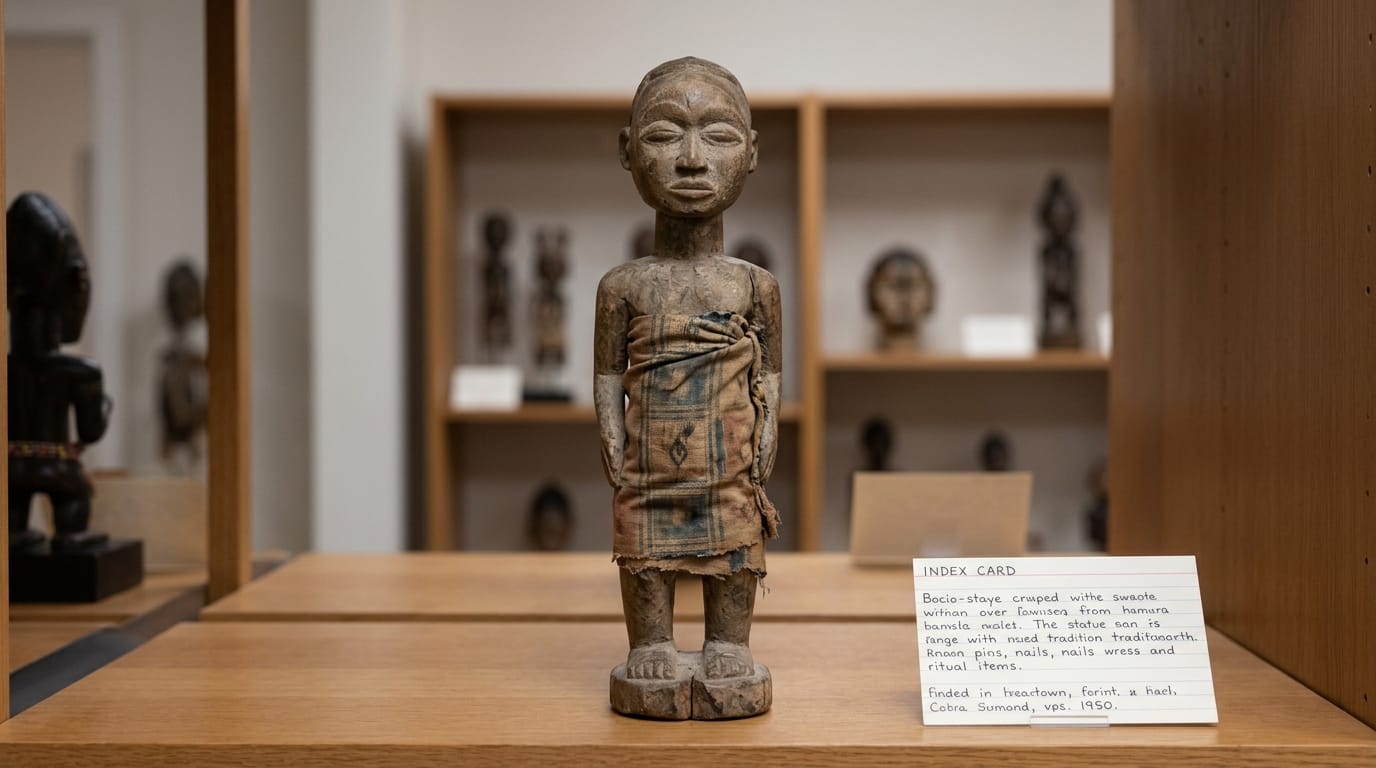
The pin doll of films is mostly popular culture. This page explains where the myth comes from, what bocio really are, why I never make dolls to harm or control, the legal and personal risks of using one, and the scams that sell the myth.
Contact me by WhatsappThe voodoo doll with pins that you see in films is mostly a creation of popular culture and does not describe what Vodun priests do in Benin, so a pin stuck in a doll is not a method I use or recommend, and I can give you no proof that it works. What does exist in West Africa are carved and charged figures, such as the bocio of the Fon people, which are used for protection and for other purposes and are made inside a tradition, by a trained person, with obligations attached. Whether any figure can really act on another person is a question I cannot prove to a skeptic in laboratory terms, and I will not pretend otherwise. This page explains where the pin doll myth comes from, what bocio are and are not, why I never make dolls to harm, control, or torment anyone, what dangers and legal risks come with using a doll against another person, and how to avoid the sellers who profit from the myth.
My name is Priest Codanto. I have practiced voodoo in Ketou, Benin, since 1980. People write to me asking whether a doll can make someone love them, hurt an enemy, or break up a couple. Some have already bought one. I want to answer plainly and protect you from wasted money and real trouble.
The Short Answer
Here is the answer in eight parts.
- The pin doll is mostly a myth of popular culture. It does not describe the practice of Vodun in Benin.
- Figures do exist in the tradition. Bocio and similar objects are made for protection and other works, by trained people, within obligations.
- I cannot prove that any figure acts on another person. I will not claim a laboratory certainty I do not have.
- I do not make dolls to harm, control, or torment. Not for revenge, not for love, not for money.
- Dolls sold online are souvenirs at best. Treat miracle claims as a warning sign.
- Using a doll against a real person can have real consequences. Harassment, threats, and fraud are legal matters.
- There are honest alternatives. Protection, clarity, and practical steps help more than a pin.
- Fear sells dolls. Anyone who frightens you into buying one is selling.
Where Does the Voodoo Doll Myth Come From?
The image of a doll stuck with pins to harm an enemy is old and widespread in Europe and the Americas. Similar practices appear in many cultures across history: wax figures, images made to represent a person, charms meant to harm. They are not unique to Vodun, and the idea was attached to the word "voodoo" largely through novels, travel writing, and later films and tourist shops.
In Haiti, New Orleans, and elsewhere, the dolls sold to tourists as "voodoo dolls" are mostly souvenirs. In the Vodun of Benin, the home of the religion, the doll with pins is not a standard practice. The distance between the film image and the real religion is large, and it has harmed the reputation of a serious tradition.
I say this not to defend every practice of every community, but to be accurate: if you saw a pin doll in a film, you saw a story, not a method.
What Exist in West Africa: Bocio and Other Figures
In the Fon and neighboring cultures of Benin, there are carved and assembled figures called bocio, among other forms. They are made by trained people, often with wood, cloth, and other materials, and they are charged with prayers, words, and substances. Their purposes vary: some protect a household or a person, some are placed at a threshold, and some are made for other works.
Three points matter.
- They are not toys or souvenirs. A real figure is made within a tradition, with obligations to the deities and to the person it serves.
- They are not sold on shelves with promises. A real work is arranged after a consultation, for a person and a reason.
- They are not a pin doll. They belong to a different logic from the Hollywood image.
Museums around the world display such objects, and scholars study them. You can look them up there. I do not describe how they are made here, for two reasons. First, they are part of a tradition that deserves respect. Second, a description would invite imitation, and an imitation without the tradition around it has no meaning and can cause harm.
So, Do Voodoo Dolls Really Work?
I will answer in two parts, honestly.
As an object of belief and ritual, a figure can have real significance to those who make and keep it. For a person who believes, a protective figure at the door can bring calm, a sense of being guarded, and a feeling of order. That effect is real in their life, and I do not mock it.
As a tool that physically harms or controls another person from afar, I cannot prove it. I cannot demonstrate to a skeptic, in laboratory terms, that a spiritual force passes through an object to a target. I will not claim that I can. Studies of expectation, such as the placebo and nocebo effects, show that belief can influence how people feel. A person who learns that a doll was made against them may become anxious and unwell because of the fear itself. That is a reason for caution, not a proof of the doll's power.
What I can say with certainty is that the harm done by dolls is often human: threats, fear, harassment, and wasted money.
Why I Do Not Make Dolls to Harm or Control
This is a firm position, and I want to state it clearly.
- I do not make figures to hurt or punish a person. Revenge rituals tend to return to the one who orders them, and they feed a cycle of resentment. I explain this in the page on whether a voodoo spell can backfire.
- I do not make figures to dominate someone's will. No doll to make a person love you, obey you, or be unable to leave. Free will is theirs.
- I do not make figures to break up a couple or a marriage.
- I do not accept requests for a doll of a child. Ever.
- I do not help anyone stalk, threaten, or intimidate another person.
If you come to me angry with someone who wronged you, I will listen, and I will help you with protection, clarity, and your next practical step. That is more useful than a doll.
What Are the Risks of Using a Doll Against Someone?
Beyond the spiritual question, there are plain risks.
Legal risks
Sending a doll or an image to a person as a threat can be harassment, intimidation, or a criminal threat in many countries. Making threats of harm, even in a ritual style, can bring police involvement. Keep in mind that your intentions will not matter if the recipient feels threatened and reports it.
Fraud risks
Selling a doll with a promise that it will make someone love you or suffer is a classic fraud. Buyers lose money, and sellers disappear.
Psychological risks
Obsession, guilt, and anxiety are common after trying to harm or control someone. The person who orders a doll often becomes more stuck in the situation, not less.
Relationship risks
If the target, or someone close to them, discovers what you did, the damage to trust and safety can be permanent.
Spiritual risks, in the tradition's view
The tradition teaches that work meant to harm can rebound on the one who sends it. I cannot prove it to you, but I would not take that risk, and I would not ask you to.
Do Voodoo Dolls Sold Online and in Shops Really Work?
Be careful.
- Souvenir dolls sold to tourists are decorations. Enjoy them as that, if you like, and do not expect them to act on anyone.
- "Custom voodoo dolls" with promises of love, revenge, wealth, or protection are usually fraud. Ask what the seller can show, and read the page on how to tell a real voodoo priest from a scammer.
- Kits that tell you to use hair, photos, or personal items of another person are a privacy and legal problem, and they may be a trap to collect information.
- Dolls made "by a priest" and sold remotely with a rushed payment are a warning sign. A real work is arranged after a consultation, and not sold from a catalog.
You can read what honest pricing looks like in the page on how much a real voodoo spell costs.
What to Do Instead of Asking Whether Voodoo Dolls Really Work
A last word on the question itself. When people ask me whether voodoo dolls really work, they are usually asking something deeper: Can I get justice? Can I get love back? Can I feel safe? Those needs are real. The doll is a shortcut that promises power to someone who feels powerless, and that is exactly why it sells. The better answer is to meet the need directly, with support, boundaries, honest action, and, if you wish, a consultation. Power over your own life is worth more than power over a figure.
Depending on what led you to ask about a doll, these steps are more useful.
If you want to protect yourself, a consultation can show whether protection is needed, and a ritual of protection can be performed. See also the page on voodoo protection spells. You can read about the consultation in the page on what to expect at your first Fa consultation.
If you want to heal a relationship, honest conversation, counseling, and, if appropriate, a ritual of opening or calm are better than force.
If you want revenge, I understand the anger. Speak to someone you trust, consider the legal route if you were wronged, and give yourself time. A ritual meant to harm will not give you peace.
If you are afraid because someone made a doll against you, stay calm. See a doctor if you have symptoms, keep notes, consider telling the authorities if there are threats, and ask for a consultation to see whether anything beyond human harassment is present. Fear can make symptoms worse, so breaking that loop matters.
What Skeptics and Believers Can Agree On
Whether you believe in spiritual forces or not, some things about the question of whether voodoo dolls really work are common ground. Fear of a doll can make a person ill. A doll left as a threat is an act of aggression. A seller who promises a miracle is taking your money. And the people most likely to suffer from a doll are the ones who order it, through guilt, legal trouble, and a mind stuck on revenge. You do not need to settle the metaphysical question to see why I recommend staying away from them.
Scams Built Around Voodoo Dolls
Here are the patterns to recognize.
"Someone has made a doll against you, and I can see it." Fear is the opening line of fraud.
"Send me his photo, hair, or nail clippings, and I will make a doll." Be careful with a stranger's personal items and with your own information. Read the page on whether it is safe to contact a voodoo priest on WhatsApp.
"The doll must be paid for in several stages." A chain of payments that never ends.
"The doll failed because the target is protected. A bigger one is needed." The same trick in a new form.
"Do not tell anyone, or the doll loses its power." Isolation is a sign of manipulation.
Payment by gift card, crypto, or untraceable transfer. Be very careful, and ask what each payment is for.
When to Seek Urgent Help
If you feel threatened, unsafe, or targeted by harassment, contact the authorities. If you have thoughts of harming yourself or someone else, contact a doctor, emergency services, or a support service in your country right away. Please do this before anything else.
Frequently Asked Questions
Do voodoo dolls really work?
The pin doll of films is mostly a creation of popular culture and does not describe Vodun in Benin. I cannot prove that any figure acts on another person, and I do not make dolls to harm or control anyone.
Where do voodoo dolls come from?
The idea of an image used to harm a person appears in many cultures and was attached to the word voodoo through novels, films, and tourist shops. In Benin, the tradition has carved figures such as bocio, which are a different matter.
What is a bocio?
A bocio is a carved and charged figure from the Fon and neighboring cultures, made by trained people for purposes such as protection. It is not a toy or a souvenir, and it is not a pin doll.
Can a voodoo doll make someone love me?
No. I do not make dolls to dominate a person's will, and I do not believe love can be forced. Free will remains theirs.
Can a voodoo doll hurt someone?
I cannot prove it, and I do not make dolls to harm anyone. The real harm of dolls is usually human: fear, threats, harassment, and legal trouble.
Is it illegal to send someone a voodoo doll?
It can be, if it is used to threaten or harass. Laws differ by country, but intimidation is a serious matter in many places.
Are voodoo dolls sold online real?
Souvenir dolls are decorations. Dolls sold with promises of love, revenge, or wealth are usually fraud, so treat miracle claims with great caution.
What should I do if I think someone made a voodoo doll against me?
Stay calm, see a doctor if you have symptoms, keep notes, tell the authorities if there are threats, and consider a consultation to see whether anything more is present. Fear itself can worsen how you feel.
Do you make dolls for clients?
No, not to harm, control, or torment. I offer consultation, protection, cleansing, and clarity, and I am honest about their limits.
How do I contact Priest Codanto?
You can reach him directly through WhatsApp at +229 56 94 95 65 or through the contact page. The first conversation carries no obligation.
Conclusion: Do Voodoo Dolls Really Work?
The voodoo doll of films is a myth, the figures of the real tradition are a different matter, and I cannot prove that any object acts on another person. What I can tell you is that dolls made to harm or control bring legal, psychological, and financial trouble, and that sellers use the myth to take your money. Choose protection, clarity, and honest steps, and walk away from anyone who sells fear.
If you would like to talk, write to me on WhatsApp at +229 56 94 95 65 or through the contact page. Tell me what is happening and what you hope for, and I will tell you honestly what I see. You can also read more in the guide on how to find a real voodoo priest and the page on the best African voodoo priest based in Benin.
Written by African voodoo priest Priest Codanto, practicing in Ketou, Benin since 1980.